
The Evolution of Nursing Management in Today’s Healthcare Landscape
Why nursing management matters more than ever
Nurse managers play an integral role in ensuring workforce stability, building strong care teams, and enhancing patient outcomes. They are the bridge between big picture health system goals and everyday frontline execution and their role is more important than ever in today's rapidly-changing healthcare environment. Nurse managers and other frontline managers are responsible for supporting the largest segment of the healthcare workforce, but must navigate rising burnout and staffing shortages, alongside changing workforce expectations, to ensure consistent patient access to high-quality care. Positioning them for success requires innovation around how they accomplish their work and connect with their teams.
Investing in modern nursing management practices better positions organizations to increase nurse engagement, boost retention, and reduce operational strain. As operational demands grow, data-driven insights and nursing-specific leadership tools are helping nurse leaders support their teams more effectively, especially when paired with strong foundations in communication, collaboration, and leadership development.
The changing role of nursing managers
From operational managers to workforce strategists - the responsibilities of nurse managers have expanded dramatically. Once focused heavily on staffing scheduling, administrative oversight, and policy enforcement, nurse managers today must also:
-
Lead interdisciplinary collaboration
-
Address high rates of nurse burnout
-
Foster a culture of psychological safety
-
Improve staff engagement and retention
- Navigate changing workforce expectations
- Promote their team's professional development
-
Support clinical excellence and quality care
Organizations like the American Nurses Association increasingly emphasize that nurse managers are critical to shaping high-performing, supportive work environments. Yet even as expectations rise, frontline leaders often have less time to connect meaningfully with their teams, especially on a regular, personalized basis. This tension, greater responsibility with fewer hours, calls for more proactive leadership tools.
How technology is transforming nursing management
Administrative burden remains one of the biggest contributors to nurse manager burnout, but leader-centric technology is helping ease that pressure. Automating routine tasks significantly reduces the amount of time leaders spend on manual follow-up and administrative coordination. Communication becomes more streamlined, workflows run more efficiently, and managers can dedicate more of their energy to coaching, supporting, and developing their teams.
When it comes to managing their teams and preventing burnout, AI-driven innovation is also making it easier for leaders to spot early signs of nurse distress or disengagement, giving them the chance to intervene before issues escalate. With large spans of control, keeping a close pulse on workforce health can be especially difficult; this is an area where AI is helping truly augment human connection instead of replacing it. Technology alerts nurse managers to the risk, while those nurse managers then take the human actions needed to connect with, support, and retain their team members.
Predictive insights improve retention strategies
Advancements in predictive analytics further informe nurse managers about the early signs of burnout. Patterns like long stretches without PTO, repeated late departures, or skipped breaks can be strong indicators that a team and/or department is under increasing strain. For example, when a significant portion of a team hasn’t taken PTO in six months, early-tenure turnover begins to climb. Consistently working extended hours is one of the strongest predictors of burnout, and teams that regularly skip breaks often experience double-digit declines in retention.
Insights like these allow leaders to intervene sooner, offer support where it’s needed most, and address risks before they translate into turnover. Research from groups like Work Institute reinforces the impact of this approach: early, informed action is one of the most effective ways to improve nurse retention.
Building consistent manager–team connections
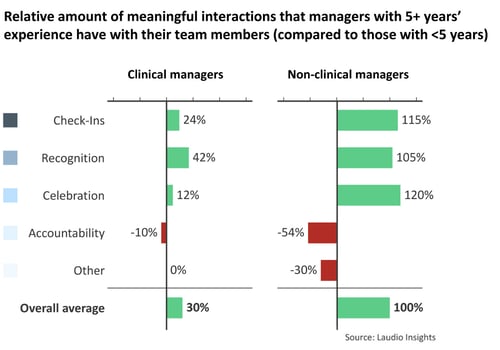 Consistent, meaningful interactions between nurse managers and their teams are among the strongest drivers of engagement and retention. Data shows that more experienced managers naturally have more of these touchpoints, especially recognition and check-ins, which helps them build trust and reduce the need for corrective conversations. These small but regular moments of connection play a major role in shaping culture and commitment.
Technology helps newer managers build these habits earlier by providing timely prompts to recognize achievements, check in with staff, or celebrate milestones. Over time, these interactions accumulate, creating stronger relationships, improving satisfaction, and supporting better retention across nursing teams.
Strategies that strengthen nurse engagement, retention, and satisfaction
1. Making recognition a core retention strategy
Recognition is one of the most powerful ways to improve engagement, especially during times of high stress. Regular acknowledgment reinforces purpose, belonging, and commitment. Teams that embed recognition into their daily culture consistently report stronger morale and improved retention.
2. Building robust career pathways
Clear career advancement opportunities are essential for retention in nursing. Successful approaches include: structured mentorship programs, leadership development initiatives, and defined pathways to advancement. These practices mirror strategies recommended by industry leaders and competitive nursing programs.
3. Prioritizing emotional wellness & psychological safety
With burnout at crisis levels, nurse managers play an essential role in creating safe, supportive environments. Effective approaches include: mental health resources, safe spaces for open dialogue, and debriefing after difficult events. Strong emotional support improves resilience, team cohesion, and retention.
4. Making equitable workload and staffing decisions
Workload inequity is one of the strongest predictors of nurse turnover. With real-time staffing and workload data, managers can: highlight and address chronic staffing gaps, advocate for more equitable assignments, and identify risk patterns that may impact patient safety.
5. Aligning organizational priorities with frontline realities
Data helps bridge strategic goals with daily practice. When managers can clearly show how frontline work connects to broader organizational outcomes, trust grows, and teams stay more engaged.
How strong nurse management transforms healthcare organizations
When nursing management is strong, the benefits ripple through every part of a healthcare organization. Communication improves, care teams collaborate more effectively, and patient care becomes more consistent and reliable. This kind of leadership directly influences patient outcomes, reducing errors, strengthening safety practices, and contributing to the higher satisfaction scores that so many hospitals work hard to achieve. Strong nursing leadership and management also provide the stability that frontline teams rely on during high-pressure moments, helping staff feel supported rather than overwhelmed.
These improvements extend well beyond the bedside. Effective nursing management is one of the strongest predictors of lower turnover, better engagement, and healthier team culture. When leaders have the tools and time to check in with their teams, recognize great work, and anticipate challenges before they escalate, retention in nursing improves dramatically. Vacancy rates stabilize, reliance on agency staffing declines, and daily operations run more smoothly because managers are able to lead proactively rather than react to constant fires.
Platforms that streamline daily nurse manager workflows—those that bring together employee rounding, recognition, voice, staffing analytics, communication, and more—help managers stay connected to what their teams need most. The result is more consistent leadership behaviors, stronger performance across departments, and an environment where nurses feel valued, heard, and supported. Over time, this creates a more resilient culture, one where nurse engagement grows, retention strengthens, and the entire organization benefits from the momentum of well-supported nurse managers.