

.png?width=300&height=300&name=Executive%20Summary%20Reconnecting%20HR%20to%20the%20Frontline%20How%20Leader%20Standard%20Work%20Translates%20People%20Strategy%20into%20Results%20(3).png) The following is based on the inaugural ASHHRA & Laudio Insights report, Reconnecting HR to the Frontline: How Leader Standard Work Translates People Strategy into Results. The report provides new insights into how innovative CHROs, HR leaders, and other people leaders partner with both their executive colleagues and frontline managers to meet organizational goals. Click here for more background on the report.
The following is based on the inaugural ASHHRA & Laudio Insights report, Reconnecting HR to the Frontline: How Leader Standard Work Translates People Strategy into Results. The report provides new insights into how innovative CHROs, HR leaders, and other people leaders partner with both their executive colleagues and frontline managers to meet organizational goals. Click here for more background on the report.
In interviews, leaders repeatedly emphasized the deliberate, foundational work of aligning an organization’s C-suite and HR teams around people strategy and supporting the operation’s frontline leaders. Leaders often discussed a new focus in enumerating, supporting, and prioritizing standard behaviors and processes in the day-to-day work of frontline managers, understanding their challenges and providing meaningful support.
HR leaders are focused on creating a shared mission, building relationships with clinical and operational leaders, aligning the HRBP model with patient care services, creating consistent and accessible support, and reinforcing the primacy of frontline manager enablement. The human connections need more than “sitting at the same table” but for the HR and operations teams to work together using inclusive language and intentional collective action.
Various workflows were described in different terms across the interviews, but all outlined common principles of Leader Standard Work. This is a framework designed to describe the behaviors, tasks, responsibilities, and processes that are core to a frontline manager’s daily work and helps ensure consistent, high-reliability leadership.
This framework was developed with the contribution of over a hundred clinical and non-clinical healthcare leaders; it offers HR leaders a comprehensive view of frontline manager work that can be used to build mutual progress on people strategy across all department types and care settings. It is important for managers to understand what is required of them as part of being a leader in the organization versus what responsibilities are at their discretion. There can be no room for critical actions to be viewed as optional, yet Leader Standard Work is not about rigidity; rather, it is about sharing a common language, clarifying roles, and identifying opportunities for meaningful human connection within the flow of daily work.
The Leader Standard Work framework begins with relational leadership and progresses to operational leadership, reflecting the principle that strong operations depend on strong relationships. In other words, achieving operational goals requires effective self leadership, teamwork, and collaboration. Several CHROs noted that Leader Standard Work is not merely an operational tool, but a way to rebuild trust and connection at the frontline.
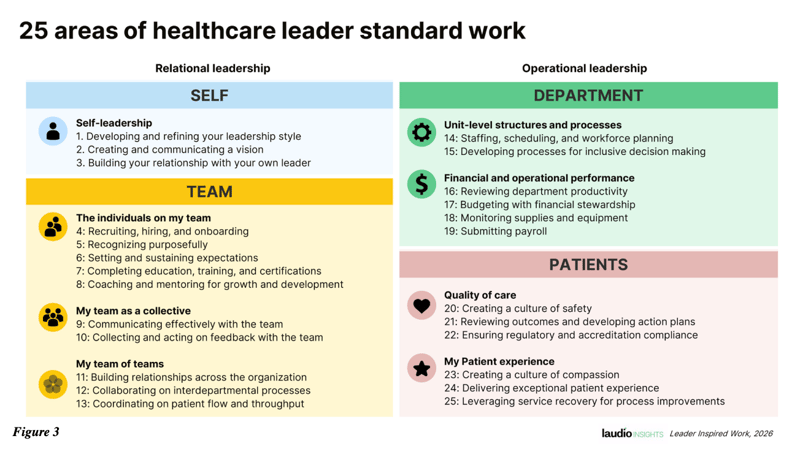
Interview insights suggest that today’s workforce pressures are concentrated in a small set of relational leadership behaviors: listening, clear communication, presence, trust building, and removing barriers to frontline work. Leaders understand their responsibilities but struggle to execute these behaviors consistently under sustained pressure. Culture is increasingly shaped through daily leadership practices at the department level, prompting HR leaders to redesign systems and tools to reinforce the most critical Leader Standard Work behaviors, including faster feedback, simpler processes, stronger relationships, and space for human centered leadership.
Organizational trust is central to the employee experience and is a direct function of managers’ consistent alignment between their words and actions. Leader Standard Work provides a predictable, repeatable foundation for building trust at scale. HR plays a critical role in embedding this framework across the organization.
Start your tour or request a demo to see how Laudio helps people and healthcare leaders drive engagement, efficiency, and better outcomes.