

What the data says
Laudio’s analysis of longitudinal workforce data across U.S. health systems shows that Gen Z registered nurses (RNs)— typically born between 1997 and 2012— have now become the second-largest generational cohort practicing in hospital settings. As illustrated below, Gen Z is also the only generational group whose relative representation continues to increase month over month, while the proportions of millennials and baby boomers are declining.
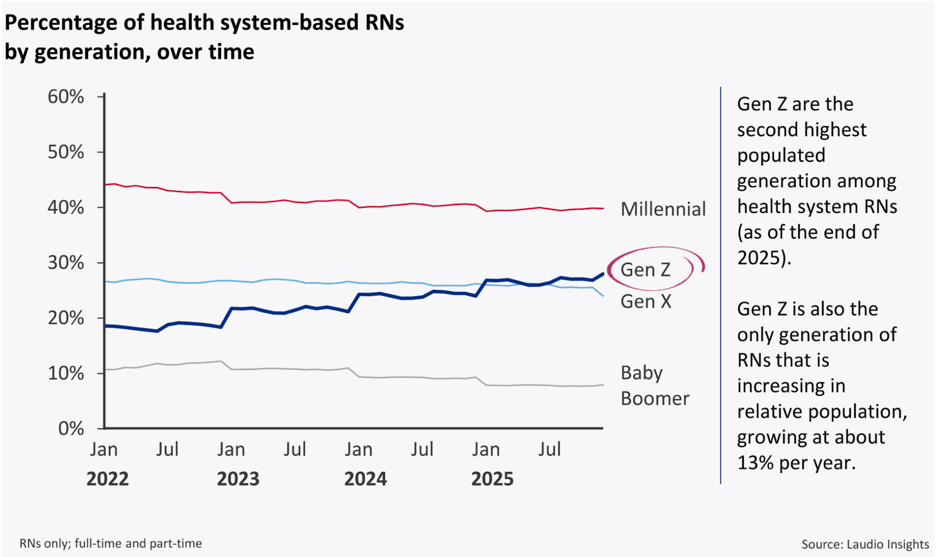
The graph also shows annual patterns, such as noticeable increases each January and July as new nursing graduates enter the workforce.
As of 2026, Gen Z RNs now make up about 30% of the RN workforce; this crosses a critical threshold that shifts their role from adapting to existing workplace norms to actively shaping these norms and culture. Malcolm Gladwell explains this dynamic as the “Magic Third”, outlined in Revenge of the Tipping Point (2024). Gladwell describes how minority groups reaching roughly 25–33% representation gain enough collective influence to meaningfully alter group dynamics, expectations and culture. At this point, behaviors and norms begin to change in ways that reflect the values of that subgroup, rather than requiring the subgroup to always assimilate.
Health systems are also beginning to see the first substantial wave of Gen Z RNs moving into frontline leadership roles, including charge nurse and nurse manager positions, further amplifying their cultural impact.
What it means
Gen Z RNs are no longer adapting to the system; they are setting expectations for it
Across discussions with nurse managers and executives from our latest report with AONL, a consistent theme emerged: the foundational elements of good leadership have not changed. Trust, fairness, visibility, follow-through and genuine care for staff remain essential. What has changed is Gen Z RNs’ willingness to hold leaders and organizations accountable to those standards in real time.
Gen Z nurses are more likely to speak up when communication is unclear, stated values misalign with daily operations, or leaders fail to follow through. As a result, leadership consistency and credibility have become even more critical drivers of engagement and retention.
Implications for healthcare executives
Personalize professional development
- Gen Z RNs expect growth to be visible, continuous, and personalized. Annual evaluations and distant promotion timelines are increasingly misaligned with their expectations. Nurse leaders report shifting away from rigid, one-size-fits-all career ladders toward skills-based, values-driven development pathways that align with individual strengths and aspirations.
- Personalized development pathways require a more active time and effort investment from leaders. Gen Z RNs value frequent feedback, coaching conversations and leaders who are directly involved in their growth. They are not seeking less accountability, but rather greater transparency about expectations and more structured support along the way.
- High-performing organizations are responding to this shift in priorities by redefining the nurse manager role to make connection, coaching, and talent development explicit and protected components of leader standard work.
- Many of today’s healthcare operating models were built around the expectations of earlier generations; this includes delaying rewards based on long-term loyalty and personal sacrifice. For Gen Z RNs, these norms are increasingly misaligned with expectations that meaningful work, professional growth, and well-being should coexist in the present.
- Gen Z nurses are highly attuned to gaps between what organizations claim to value and what daily systems reinforce. Chronic understaffing, redundant documentation and poorly designed technology are not seen as mere inconveniences but instead signal how seriously organizations value nurses’ time and expertise. For Gen Z, values are more than aspirational statements; they are critical proof points for the alignment between what an organization claims and how work is actually structured day-to-day.
- Innovative health systems are actively re-engineering their environments to address these challenges. This includes redesigning staffing models, streamlining workflows, clarifying roles, and integrating technology in ways that reduce friction rather than create it. Importantly, leaders emphasized that these improvements are not only about efficiency; they are about demonstrating respect and building trust.
Adapt organizational structures and systems
By aligning people, process, and technology, organizations can create workplaces where Gen Z RNs are able to thrive as emerging leaders in the healthcare workforce.